Uncategorized


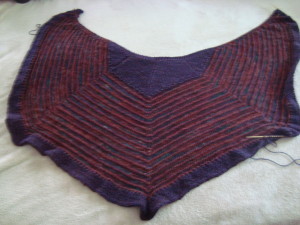
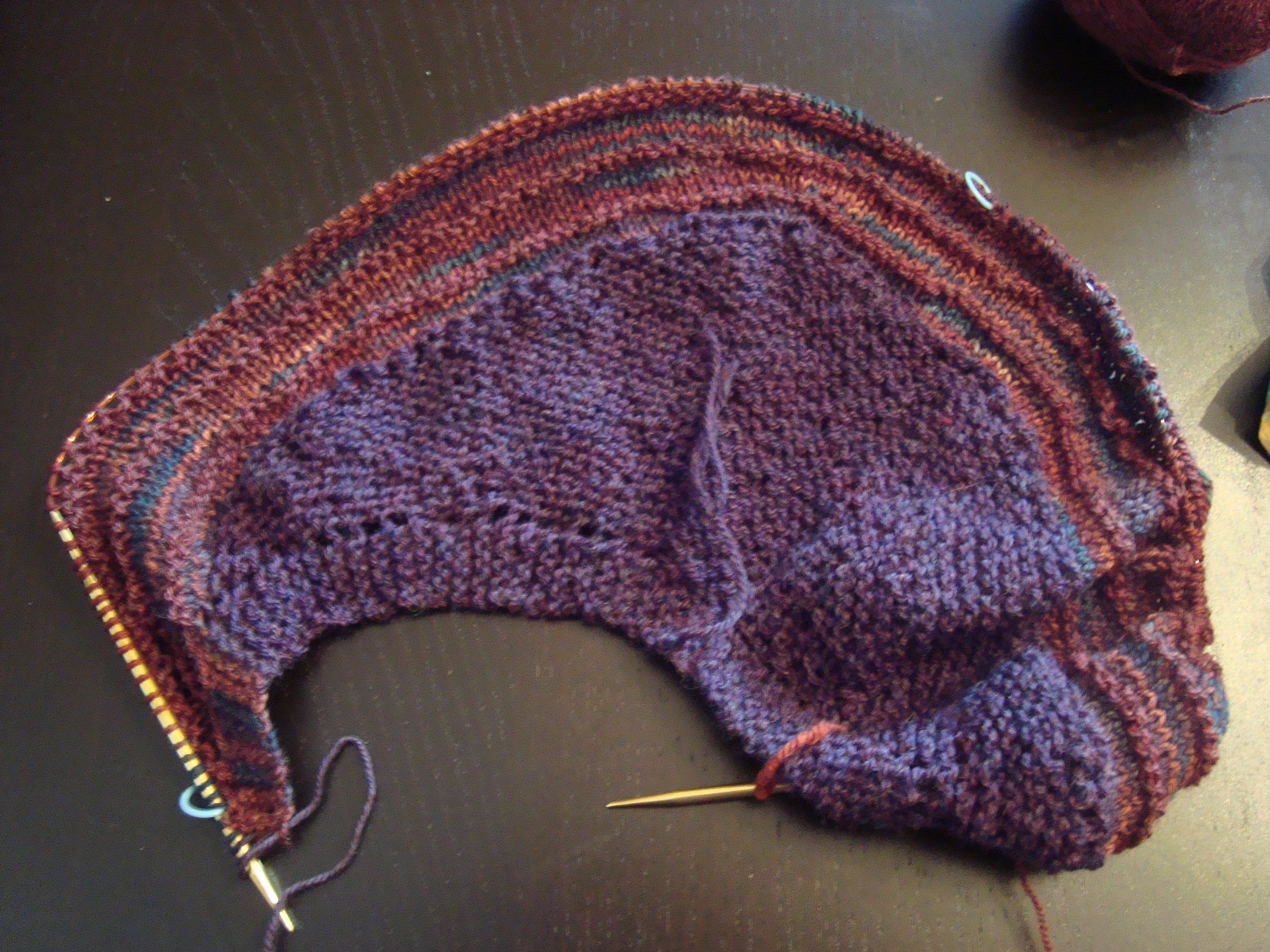
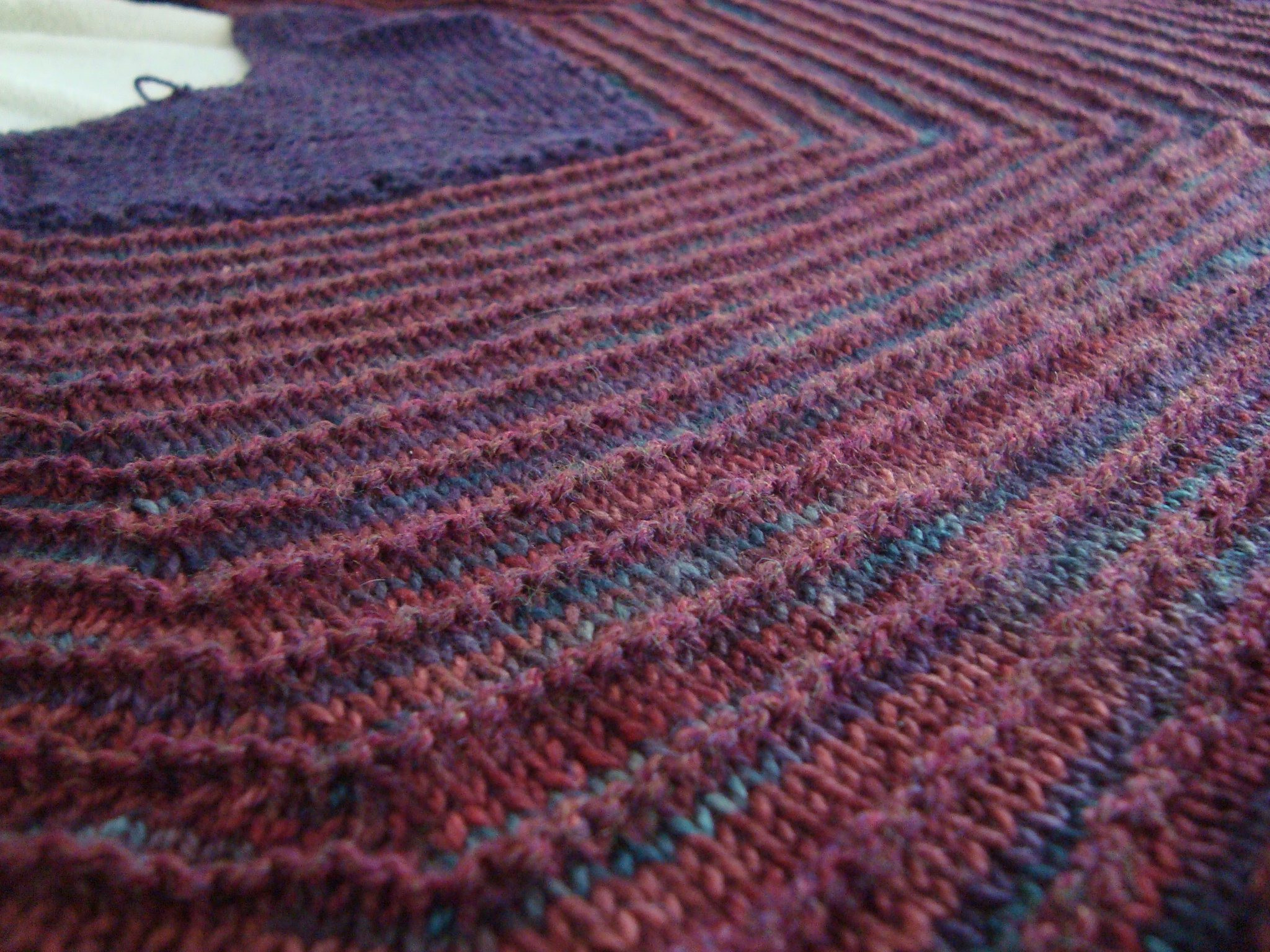
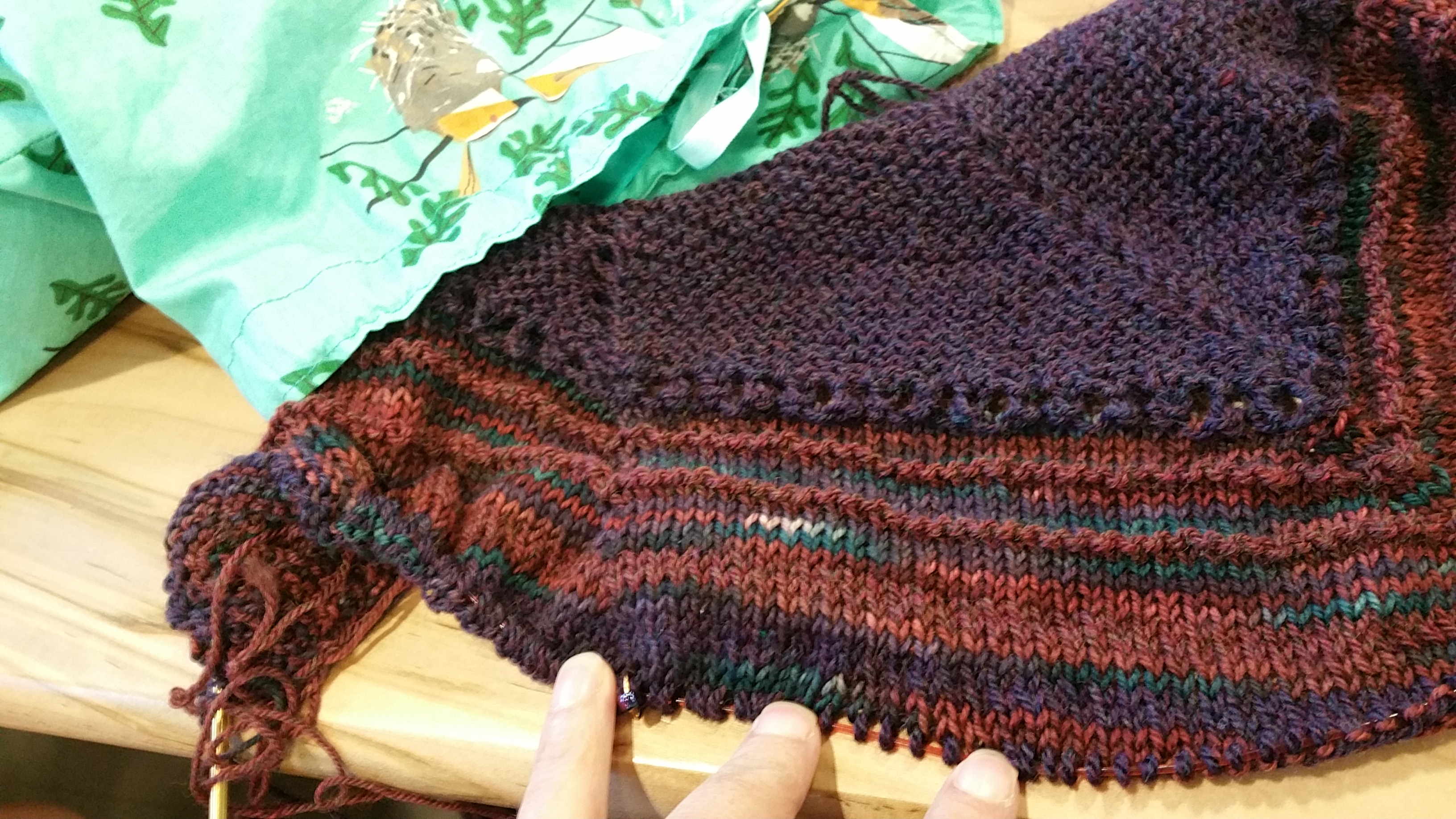
The nice thing about finishing a bunch of sweaters is that there is suddenly room on my needles for new projects. First up on the list is the re-make of the lace ribs vest, this time as a long-sleeved version.

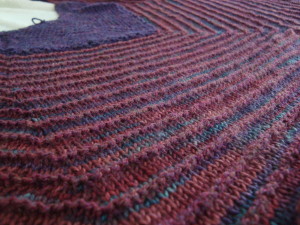
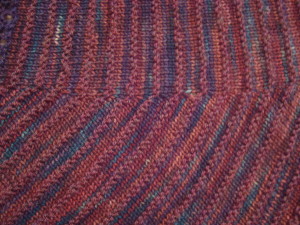
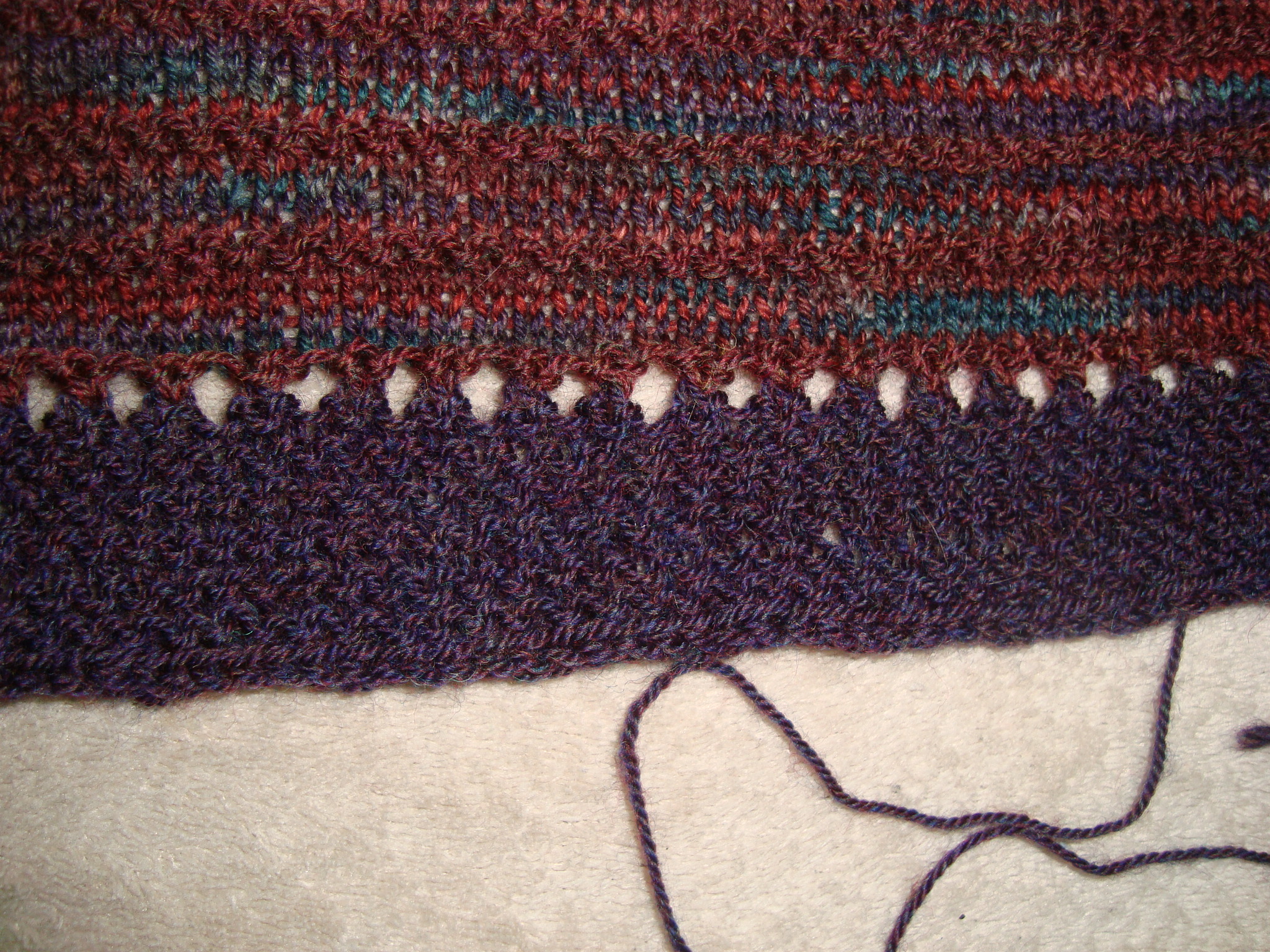
I love the color. It’s not showing up quite right in the photo, but it’s a beautiful, saturated purple-red from Dream in Color (called Velvet Port). It’s a semisolid, and its subtle color changes are just right for lace. Very happy with how this is coming out.

I also finished spinning the fiber that I showed last time. It’s a reject from the shop, and has been sitting in the stash for quite some time now. I decided that it was time to pull it out and do something with it, and was hoping to get enough for a pair of socks. I ended up with just about 300 yards of fingering-weight 3-ply, which is definitely finer than I’ve been getting from the other flyer.

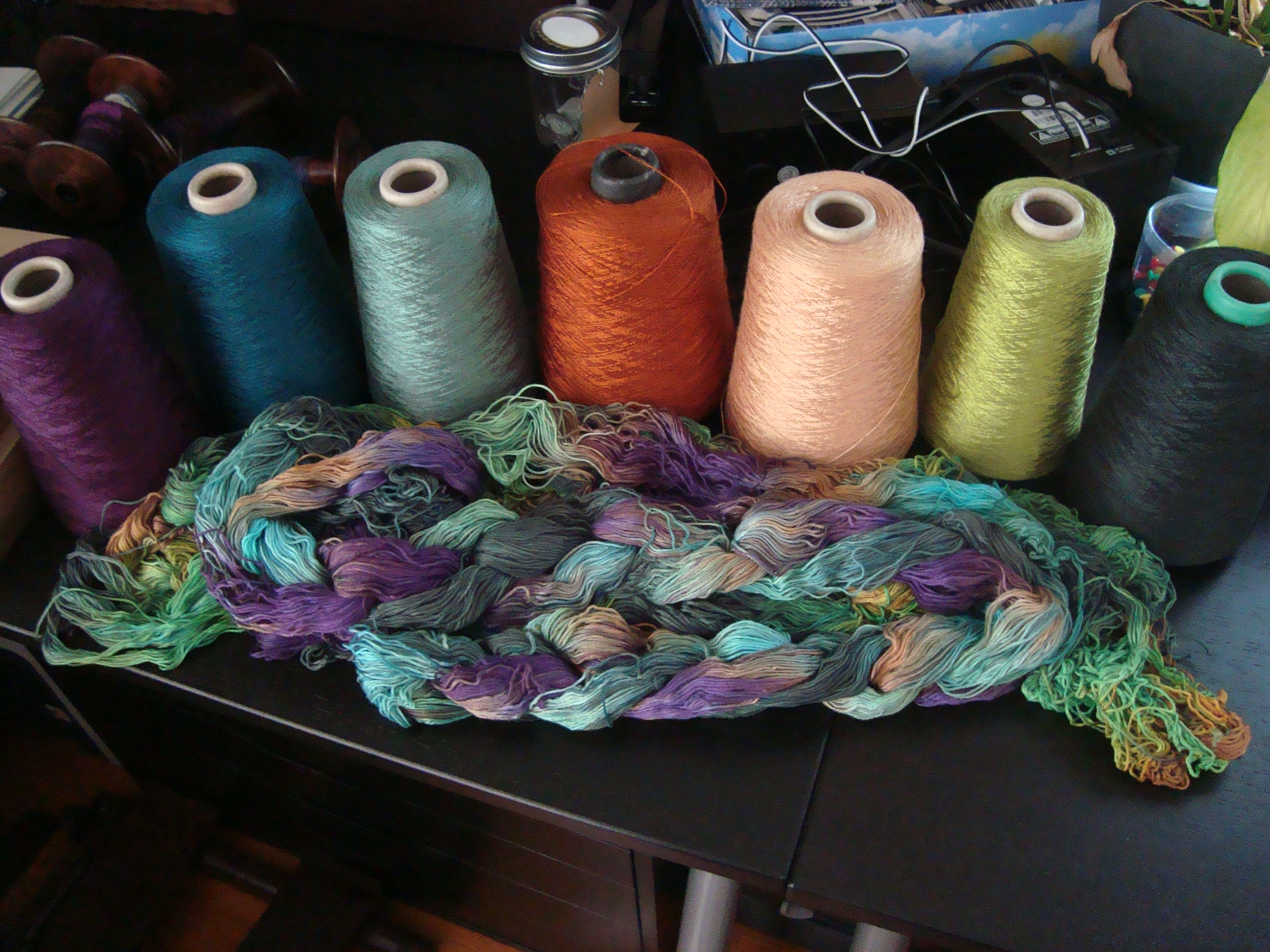
I apparently forgot to take a picture of the yarn by itself, so here it is with its new partner (also an outcast from the shop):

Or what I think will be its partner. I’m still not 100% sure that those colors go together. In some lights I think they’re perfect, and in others I’m not so sure.

Since the yardage on the first yarn is just a little short of what I was hoping for, I am now dreaming up new ideas for this project, and I have a sneaky suspicion that it might become a shawl instead of a sock.

Here’s a picture of the second fiber comparing the dyed top and the singles:

I always like to compare the way the colors look on the fiber and in the yarn. It helps me figure out how to dye toward a particular effect. I’m often surprised by how much the colors even out in the spinning. This fiber is dyed with color patches that are just about a staple length, and in some cases shorter. None of the colors have very high contrast, and it’s turning into a nicely blended yarn, but with some variegation in long sections. I’m planning to chain ply it like the last one, so it will be interesting to see how much variegation remains in the final yarn. I’m almost out of space on the bobbin, so I’ll be plying soon!

The last of the projects is the one I’m most excited about. We’re gearing up to make a (really, almost scary) big fiber order for the shop, so that I can start dyeing towards a fiber festival or two this spring. Last weekend, I went poking around online, and today this was on my doorstep:

That’s a terrible picture of some beautiful fiber (it’s really creamy white…my house is just dark). It’s 100% Targhee, from Sweet Grass Wool. This is just a small purchase to check the quality of the fiber before thinking about buying more, but if the spinning is as good as the smooshing, I am 100% sold. I’m especially happy about buying this fiber because it’s one that I can buy direct from the farmer rather than through a distributor. The rest of my wools are bought through a small company in Vermont, but they are still a distributor, and I like to work with a farmer whenever I can.

I’m also thrilled because, well…it’s just amazing wool.

There will be more on that soon, I’m sure, and then there might be some Rambouillet in the mail, too. All kinds of new things popping up over here…

Last weekend, I was having a hard time getting back into the swing of dyeing after the holidays. I have a bunch of ideas simmering on the back burner, but none of them was quite ready to go. And then, Linda asked if I ever dyed semisolids to coordinate with my more variegated colors.

That seemed like a manageable goal for the first dyeing session of 2012, so I set to work mixing up multiple dilutions of single colors, and then began painting them onto the fiber in layers, mixing and blending as I went. Most of my semisolids have just one main color, with occasional highlights here and there.

Using the base dyes that make up a majority of my color mixes, I have a rainbow of semisolids that will pair well with a lot of the fibers that I dye. In order, that’s Semisolid Red, Orange, Jade, Teal, Spruce, Sapphire, Navy, Berry, and Brown. These colors are deeply saturated, and often mixed with a touch of black to deepen the shadows even further.

(They are also nearly impossible to photograph, because they are so saturated and have a similar set of hues, so there’s nothing for the camera to use to color balance them. If I dye many more of these, I  might have to start worrying that Branden will quit as my photographer. This really is too bad, because I really like them.)

I also dyed a few tinted grays:

That’s Blue silver, Storm Gray (more of a gunmetal than a silver color), and Silver Rose. All made using a couple of low-saturation grays, with tiny bits of color added here and there as highlights.

And now, for the fun part:

1) Semisolid brown and Fallow Fields

2) Semisolid brown, Fallow Fields, and Alaska Mountain

3) Semisolid brown, Fallow Fields, and Cocoa Berry

4) Semisolid brown, Fallow Fields, and Semisolid Jade (I like the Brown and Fallow Fields together, can you tell?)

5) Semisolid Jade and Cocoa Berry

6) Semisolid Jade and Storm Green

7) Fall Reflections and Semisolid Sapphire

8 ) Fair Winds Peacock and Semisolid Spruce

9) Fair Winds Peacock and Semisolid Sapphire

Both Sapphire and Spruce are used in the Peacock colorway, and it’s interesting to see how mixing with the semisolid brings out those different aspects of the color.

10) Fall Reflections, Semisolid Orange, and Navy

11) Semisolid Spruce and Sapphire

12) Semisolid Sapphire, Sea and Sky, and Whitecaps

13) Semisolid Sapphire and Blue Silver

14) Silver Rose and Semisolid Berry

15) Semisolid Berry and Alaska mountain

That last one wins hands down as my favorite of this group, with the Jade and Storm Green following close behind. Despite strong temptation to keep a few aside, they are all available on Etsy.

And, just like that, I’m back in the swing of things. I don’t know if I’ll get to dye this weekend, but I have at least one and probably two sessions plotted out. I’ve been collecting photos on Pinterest like crazy, and I’m sure there will be lots more colors coming soon. Sometimes all it takes is returning to basics to get that jump start.

I somehow thought that my first week of unemployment would be quiet, a chance to work on projects, do some reading, and generally decompress from the crunch of finishing off my fellowship.

Not quite.

So far in January, I have submitted one manuscript, been asked to author another, been sent a third to proof and review (has my name on it, but didn’t know it was coming until Wednesday), and been sent a set of figures to critique for another that’s been in limbo for almost a year. I’ve heard that one job possibility is likely not happening, and decided to apply for a faculty position, which is a whole ‘nother kind of application. The last few days have been consumed by writing teaching statements, assembling a portfolio containing all of my previous teaching experience, and starting the application process. Next week, there’s a research proposal to be written, and funding to be thought about.*

And this is unemployment?

Needless to say, not much crafting has happened this week, despite my plans. I did attend a weaving guild meeting on Thursday (the first time I’ve been able to go, because they meet during normal work hours), and last night I managed to sit down and spin for a little bit with my new flyer. It’s coming out much finer than I was able to achieve before, and the bobbin is almost full.

I’m hoping that this will turn into enough fingering-weight 3 ply for a pair of socks. There’s not much spinning left, so we should know soon!

And I am determined that this swatch will turn into cast-on stitches for a new project by the end of the weekend.

It’s been sitting by my knitting chair since last weekend, just waiting to be measured so I can calculate a stitch count and cast on. That sounds like a reasonable goal, right?

*Just for the record, all of these are good and exciting things; just not what I’d expected to be doing this week. It might be a bit of an understatement to say that I was caught a little off guard.

After blocking and drying, Bright Lights was finally ready for surgery this morning. I’ve installed plenty of zippers into sewn clothing, but I’ve never attempted to put one into my knitwear, and I’ve never done a full-length steek, so I was pretty excited to get started.

First, I tried it on in the pullover version to get a few more photos, and to measure the length of the sweater front when worn.

Then, I went to the swatch. I wanted to try a crochet-reinforced steek, but realized at the last minute that the black yarn is superwash, and so decided that a machine-sewn edge would probably be a good idea. First, I sewed a row of straight stitch, cut the steek, and then pulled and tugged at it to see what it could withstand.

The answer was: not much. I managed to get past the sewn stitches pretty easily, and then the inner stitches started to unravel. Clearly not what we’re going for here.

Next, I tried a zigzag stitch instead, with a width and length about the same as a single knit stitch at my gauge. This stood up to wear much better.

I did manage to get a few small ends to pull loose, but couldn’t get past the machine stitched line, even after several minutes of picking and tugging at it.

While doing the machine stitching, I discovered how easy it is to slip over a stitch or two and end up with a crooked line. I wanted a straight steek, so I decided to use some of the contrasting yarn to make a marker to guide my sewing.

Then, I stitched a line of zigzag on either side of the marker stitches. (You can just barely see it here, if you squint.)

Once the edges were sewn, it was safe for steeking. I put a book between the layers of knitting to make sure I didn’t snip any stitches in the back panel, and started cutting along the marked line, pulling out my marker yarn as I went.

This is about the point that Branden came in to see what the gleeful chuckling was about, and took an action shot.

Here’s the raw steek after cutting.

Next, I rolled under the edge stitches (where the machine stitching is), and pinned the zipper in place. I made sure to use the length of zipper that I’d measured while the sweater was on my body rather than following the length that the steek seemed to suggest. If I’d pinned without measuring, I probably would have used 2-3″ more zipper, and it would have buckled when worn. (Thanks to Grumperina for that tip!)

Once everything was pinned in place, I tried the sweater on again to make sure everything was behaving properly.

And then I began tighly handsewing the sweater to the zipper. I could have done this by machine, but handsewing let me get closer to the zipper, and it gave me more control over the very edge stitches. (More control is always good, yes?) I made sure to adjust the fold so that my stitches fell in the valley between two columns of knit stitches, and to use the same column of knits the whole way up the front. The sweater edge tended to roll while pinned, so I needed to be extra careful to check as I went to make sure that nothing had shifted.

I was also careful to line up the folded edge of the sweater so that the zipper teeth were just barely poking out from underneath. I pinned it with a little more zipper showing the first time, but the zipper was really obvious when I tried it on. Tucking the teeth further behind the sweater made them much less visible in the final piece.

When the zipper was sewn in, I checked to make sure that I’d caught all the raw steek edges. You can see them tucked in there, right in the crease where the zipper meets the sweater fabric.

Then I whip-stitched the zipper flap in place, to protect those ends just a little bit more. This was a little trickier, because I needed to be sure to ease the zipper to fit the garment shaping. Since the zipper is stiffer than the knitted fabric, you want to make sure that it bends along with the sweater curves, or you’ll end up with lumps and bumps. Fortunately, it was pretty willing to follow the sweater shape, and then it was just a matter of whipstitching the curves in place.

Alternatively, I could have left the zipper tape free-hanging. It would have been secure enough, and it’s much more flexible when it’s not tacked down. I think it looks more finished this way, though, and it adds just a little more protection for those superwash ends.

And that was it.

Here it is, all zipped up.

And half-zipped (the way I’ll probably wear it most of the time).

I think I see more zippered cardigans in my future.

No matter how many projects I have on the needles, somehow it seems they all finish at once. I usually like to split things up in to smaller pieces, but just for today, here’s a monster post to get us (mostly) caught up.

Just before the holidays, I put the final touches on the lacy Falkland sweater:

I love the way the lace flows in the design, but when I tried it on, it looked a little too stretched for my taste.

The sweater does fit, but it’s a little tighter and a tiny bit shorter than I wanted. I’d figured out the sizing based on what I thought I could get from the yarn I had, and I came pretty close to using it up. I don’t think I could have squeezed another vertical lace panel in there if I’d tried, but that’s what it would need to fit me the way I wanted it to.

But I love the sweater, so I hemmed and hawed and tried to convince myself that I’d wear it anyway. We’ve been down this road before. I knit something, love it, am sure I’ll wear it, but there’s this one little thing about it that bugs me. Then I think of someone else that might wear it. And it becomes theirs. Even if I don’t give it to them, I’ll never wear it without thinking that it would be perfect for them. Once I’ve seriously considered giving something away, I never wear it again.

And so, the sweater went to my younger sister. She’s about three inches smaller than I am, which gives her just about the perfect fit. I was worried that she wouldn’t actually wear it (she’s at that tricky 14-year-old stage), but then it kept popping up all through our visit. I think she likes it.

I had planned on knitting another version of this sweater anyway, in a commercial yarn to test the pattern when I eventually finish writing it. I was thinking of using something from Blue Moon Fiber Arts or Briar Rose, but then I saw the perfect color in a yarn from Madeline Tosh while we were poking around in a local yarn shop at home.

The yarn is slightly lighter weight than I had planned, but the color is just what I was thinking, and there is enough of it. This is second (or possibly third) project in line on my knitting list for the new year.

Just as we were about to leave the yarn shop, I spied something that was instantly added to the cart.

I have been stalking the Alice Starmore books for years, online, in used book shops, and on library wait lists. I couldn’t bring myself to pay $400 for them, but a couple have just been re-released by Dover. I knew they were coming, but I hadn’t seen them in the wild yet. I don’t make many instant decisions when it comes to buying crafty things, but this one was absolutely clear. I’ve barely had time to open it, but I am really looking forward to exploring these pages very soon.

On the same day we took pictures of the lacy sweater, I managed to get a couple of Branden’s MacGyver sweater as well.

I am amazed at how warm woolen-spun shetland has turned out to be. I had always heard that a low-twist, woolen-spun yarn is warmer, and having knit this sweater I definitely have to agree that it’s true. I think the non-commercial roving had something to do with it, too. You just can’t get that much loft out of a commercially processed top.

My hand-combed Gulf Coast spun up lighter than anything else that I have done. I ended up with one skein for my friend, and another, smaller skein for Shelley (who doesn’t knit but raised the sheep). I can’t wait to spin the rest of this fleece, but there’s a lot of hand processing left to do before I get there. Another project to begin the new year.

And then, this morning, I finished weaving in ends and put the neckband on the Bright Lights sweater.

It still needs a steek and a zipper installed, but those need to wait until after it’s been blocked. I love the way the colors stayed in register the whole way through the knitting. I’m also pretty happy with the back accent stripe, though the upper sleeves are a tiny bit tight (which will block out), and so they pull the stripes and shoulder seam a little too far toward the upper arm in this photo.

Here again, I’m glad I didn’t add any extra ease on the sleeves, because this is all I had left at the end of the project.

I had hoped to cast on for my next project while we were home for Christmas, but the busyness of the holiday ensured that that didn’t happen.

This is Dream in Color Smooshy (with cashmere) in the color Velvet Port. It is destined to become a long-sleeve version of a vest that I knit just before we left Seattle, two and a half years ago now.

The new version will be my test piece for the first pattern that I’m writing up, and hoping to publish in the new year.

So that’s that. A bunch of finishing, and some new things coming. I’m excited about re-knitting the two lace sweaters, and I’m hoping that will fuel my push to get the patterns written up. The first one was mostly done, but then I decided to tweak the way I’m writing it and now am back almost to the beginning again. I think the new way will be better and clearer, and possibly even easier to write than the old way, so the changes are good, even if they do slightly delay my casting on. As always, there is much to learn.

And now, I’m going to go soak the Bright Lights sweater so that I can start learning all about steeks and zipper installation. Wish me luck!

Just a quick note between packing for our trip (tomorrow) and celebrating our anniversary (today) to say happy solstice to you all. I’m not a religious/spiritual type, but I love knowing that this is the darkest it’s going to get this winter, that it’s time to open our arms and welcome back the light. Spring is a long way off, but the corner is already partly turned. For all that it symbolizes, I hope you have a wonderful Solstice.

Yesterday, I suddenly realized that it has been a week since I touched my knitting. I sewed some buttons onto the lace sweater on Monday, but other than that I had done no work on knitted garments all week.

That’s partly because my fellowship is ending in a couple of weeks, and so suddenly everyone wants the impossible from me before I go. (No matter how much you plan, it seems this always happens. I’m trying to remind myself that the important things will get done, and the rest…well, the rest will get left for someone else.)

It’s also partly because I’ve been spinning this:

That’s the first of the greens for the fall colors sweater, which is getting ever closer to being ready to cast on. I’m loving the spinning, and the colors are great, but I needed it off my wheel so that I could do a little bit of last-minute Christmas spinning.

Those little clouds of fiber are some of my hand-processed Gulf Coast fleece, which is beautifully soft and fluffy. The bounce in that fiber is just amazing. These little bits of combed top are destined to become a skein of yarn for a very good friend and beginning knitter who was with me when I bought the fleeces. I’m also hoping to get enough for a small skein to send to Shelley, so that she can see the yarn that came from her sheep.

Here’s a sample, spun up in a light worsted weight:

I can’t wait to spin some for myself! Of course, there’s a lot of carding and combing before then, but I think that seeing this bounce might just be enough to get me going on that project again.

And then, Branden gave me an early anniversary gift on Friday. I’ve been working on making my yarn finer and finer in hopes of one day weaving with the yarn I spin, but I’ve been having a really hard time breaking past the fingering weight range on my wheel. I can get a heavy laceweight if I really work at it, but it’s a struggle to keep an even yarn. I’m sure that some part of that is just my skill as a spinner, but some of it is also because of the ratios on my wheel.

Branden solved the second problem by getting me a lace flyer. I’m not allowing myself to touch it until the Christmas spinning is done, but I did spin a few yards of singles, just to see how much of a difference it made.

Even on the “low twist” setting, I’m getting singles that are much, much finer and very consistent. I might just get to laceweight in the new year!

I don’t know about where you live, but it has suddenly turned to winter here. The last of the leaves have fallen from the trees, and the air is taking on that cheek-stinging quality of a winter chill. We’ve even gotten a snow flurry or two, certain proof that winter is on its way.

Before we say goodbye to fall entirely, though, I wanted to revisit some of the fall colors in my dyepots. I know I can never get enough of these colors, and judging from the comments section I’m guessing that most of you feel the same.

One of the fun things about dyeing more frequently is how much it changes the way I see color in the world. I’ll be driving along on my morning commute, and there’s a new colorway around every turn. When I look at art, I notice more about how light and shadow combine, and I’m constantly looking for the colors within a color (is that a blue-brown, or a pink-brown? Or maybe grey with a hint of green and a tinge of orange?).  What’s even more fun is that it seems to be rubbing off on you, too.

My friend Carolyn is off on a great antarctic adventure at the moment, but she sent me this photo from a trip to Alaska, asking if I could make it into a colorway.

Do you see all those colors in the brown? There’s green, and yellow, and especially red in there. There’s the grey-blue of the clouds, and then the grey of the mountains, and the deep gold of the autumn leaves at the foot of the photo.

When I first saw the image, I knew that I wanted to dye it as a gradient, with all of those colors stretching from one end of the fiber to the other so you could spin your way from the leaves all the way to the mountains and sky. I laid the fiber out for a two-ply yarn, and then began painting each section. The sky was a combination of pale green-blues and grey, almost too faint to see on the white of the fiber. Then came the blue-gray of the mountains, fading into brown overlaid with reds, orange and green. At the very end came a touch of gold, mixed with browns to keep it from being too yellow to wear. Each section overlaps slightly with the next, and I used the same dyes across the fiber to make sure that they’d end up in harmony. I also made sure to leave areas unsaturated with dye to capture the variation in light and dark in the texture of those hills.

I also dyed a dappled version, with all the colors mixed together.

Here, the reds bled into the greys in places, which brought out a little bit of unexpected pink, and the whole colorway leans a bit more toward the gold (note to self: yellow is a dominant color. A little goes a long way). Both colorways have a bit more blue in them than the original photo, because I mixed in a navy dye to make the greys. On my sample cards, that mixture gives a very rich slate blue; here it leans a bit more toward a denim color.

(Since Carolyn is in Antarctica and can’t really check email all the time, she got to pick her favorite before I published this post, so the long gradient fiber won’t be in the Etsy post.)

Next, I started on a a series of inspirations from the Twinset blog. (You two really do take good colorway photos. I could keep going for months, just stealing pictures from your blog.)

Back in October, Jan posted a picture of the early snowfall that hit D.C.

The one on the far left of the second row really caught my eye. All those bright reds and yellow-greens, laid against the black of the branches and the white of the newly fallen snow. When Jan first took this picture, I said that I didn’t think I’d be able to get wool white enough for the snow. But then I dyed the Whitecaps colorway with the new Falkland fiber, and thought again.

It didn’t come out absolutely white, because red dye always leaks on the first washing. I washed the heavily dyed sections first, and then rinsed the whole fiber together, so the bleeding was limited, and I did end up with some sections of pure snowy white.

Then, there were two photos from Ellen’s fiber retreat, also in October (must have been a good month). The first is one that I’m calling Fall Reflections:

Unlike the other fall colors I’ve dyed, this one is tempered by a lot of grey and even a touch of green (look at the water, just under the tree line). And then, of course, there are the fiery colors of the trees themselves.

Again, my grey leans a little blue, and I didn’t catch quite as much of the orange as I was hoping for, but it is in there. This fiber holds almost the whole rainbow, really.

Finally, I turned to the last image in the same post, a beautiful photo of steam rising off of the water.

The contrast in this one really fascinates me. There are the black, black shadows of the trees, and the pink-white of the mist over the pale blue surface of the water. I also see a little bit of brown in the mist, just at the edges where it mixes with the black.

Here, I almost need a touch more blue in that grey, but this has to be one of my all-time favorite colorways, if only because it goes so well with all the colors I love. Last time I posted about dyeing, we took a few paired photos as an experiment, and it instantly became my absolutely favorite part of taking fiber photos for the blog. It is so much fun to dig through a box of fiber and see what goes together! (As Branden patiently takes a hundred more photos…)

Rather than go through them one by one, I thought we’d try a composite image this time (click to enlarge):

1) Alaska Mountain (gradient version) and Misty Water

2) Misty Water and Sea Green (links go to the original post for the colorway – all of these colorways are also available on Etsy as of this posting, except for the Alaska Mountain gradient)

3) Misty Water and Fallow Fields

4) Fallow Fields and Alaska Mountain

5) Fallow Fields and Early Snowfall

6) Fallow Fields, Early Snowfall, and Fire Maple

7) Alaska Mountain and Storm Green

8 ) Alaska Mountain and Red Oaks

9) Fall Reflections and Fire Maple

10) Fall Reflections and Sea Green

11) Alaska Mountain (gradient) and Alaska Mountain

We’re always more careful to get good color on the individual fiber photos, so it’s good to go back to the original post if you want to see the exact colors of one of the fibers. Still, I like seeing the two colorways side by side like this, and it’s fun to figure out what different combinations will go well together. Each pairing highlights different aspects of the fiber; sometimes a particular color is the dominant one, and sometimes it almost disappears. By changing the partner colorway, you get an entirely different effect. Look at the Alaska mountain with Fallow Fields (#4) and with Red Oaks (#8), or even with Storm Green (#7). You’d get a completely different yarn from each one of those.

I’m sure these fall colors will be back again one of these days. For now, I’m really enjoying this last little burst of color before we give in to the winter grays.

I usually knit one piece, pullover sweaters. The kind that don’t need all kinds of little doo-dads to finish up. You cast off, weave in the ends, block (if I feel like being good), and bam! Instant sweater.

It just so happens that both of the projects currently on the needles are a little more complicated than this. Both are cardigan style, one is pieced. One needs a zipper, and the other needs buttons.

The lace sweater has been finished for a while now, except for that critical part where I go out and buy buttons. Here’s a terrible picture to give you an idea of where it stands:

Sorry for the backlighting; unfortunately it’s all or nothing with light lately, and I decided that I’d take what I could get.

This weekend, we finally made it out to look for buttons, in a marathon errands-running session on Saturday. I have a couple of options that I think will work, and now just need to sit down and sew them on, and attach the grosgrain ribbon button band reinforcement.

In our travels, I also picked up some of these:

I had never seen them before, but two people in my knitting/spinning circle have been using them lately, and they swear by them. They’re little plastic bobbins, and you can wrap a few yards of yarn inside to keep things tidy while doing intarsia. Unfortunately, this weekend was too late for them to be helpful on this project:

But now I have a set for next time I am inclined to work with lots of tangly ends. (All things considered, though, I found it very easy to work with the intarsia ends wound as small skeins. As long as I kept an eye on them, they were beautifully behaved.)

Here’s the back:

We also picked up a zipper for this one, and I’m looking forward to my first ever full-front steek and zipper install in the near future. I’ll probably finish the sleeves first, though.

I’m also realizing that I need to start planning my holiday travel knitting. The sweater came with me to Florida a couple of weekends ago while we visited Branden’s grandmother, and I can probably take along a sleeve or two when we go back to Massachusetts late next week. But I’m thinking I’ll need a couple of other projects on the needles, too. Our yarn shop mission on Saturday was also partly a yarn scouting tour for another project I have in mind, but I didn’t find quite what I was looking for. I know where to order it online, though, so I might get it in time to take with us.

Other than that, I think a stash toss is in order, to see what might be hanging around in there that just needs to be cast on next.

It’s been a bit quiet over here on the blog lately. I’ve been working away on projects (more on those soon, but I still need to take pictures), and I’ve been plotting and planning about new things to come for DesigKnit.

I find that fall and early winter are some of my most creative times. The rest of life gets a little less distracting as the weather gets colder and the dark draws in. The fading fall colors highlight the passage of time, and another year ticks by on my mental calendar (I think it’s probably all those years of school that make my new year begin sometime around September). And so, naturally, I begin to think of things to come.

It was around this time last year that I decided to try a little experiment that has turned into our dyeing adventures here on the blog. It’s been an interesting year; lots learned about shopping carts and shipping, and about finding the right balance for me between Etsy content and general blogging. It’s been really fun to have you all along with me, sending photo ideas and squealing with excitement when I get a color just right.

I’ve learned a lot about making the dyeing (and posting) process work for me, without becoming something that I dread “having” to get done, and I’ve realized that I really do want to do more of it. I also know (and have known from the beginning) that it’s not possible for a handful of dedicated blog readers to find a use for all the fiber I now want to dye, no matter how enthusiastic and supportive they may be. (And thanks for that support! This wouldn’t be nearly as much fun on my own.)

So, finding new eyes for my fiber is first on my list of things to do in this next year. I’ve been thinking of various ways to approach this, but the best option seems to be vending at a couple of local fiber shows. I’ve been tossing this idea around since sometime last summer, but now I’m moving toward making more concrete plans.

This past year I have paced my dyeing to match the shop; not getting too far ahead of the amount that things are selling. Now, it’s time to start building up more of an inventory, so I can start dyeing more and stashing it away in boxes for the summer. There will probably be a dyeing post every couple of weeks or so; not much more than there has been, but I may experiment with a wider range of colorways for each day rather than limiting myself to my standard four.

I’m excited about the freedom that this opens up, to dye what I feel like and trust that it will find a use and a home somewhere. There’s been a similar freedom in dyeing for the Etsy shop; I’m much more open to experimenting on 4 oz of fiber than on a sweaters’ worth of wool, and I can dye colors and combinations that I wouldn’t necessarily expect to want to wear, because they will be perfect for someone else (and often, unexpectedly, for me). Sometimes more variation seems like a really wonderful thing.

I’m also thinking about revisiting some patterns that I have nearly written and that really only need polishing up. This is a tricky one for me, because I spend all day being very precise, careful and exact at work. Coming home and thinking hard about being precise, careful and exact in knitting isn’t always high on my list. But my fellowship is finishing up in a few weeks, and I may have a few months before anything else comes along, so this seems like a good opportunity to pull some old projects together and finish them off. I count at least 6 designs in my notebook, ready and just waiting to be turned from a tangle of charts and scribbled instructions into something more useful.

Then there are the new designs that are still coming. So many ideas, just waiting their turn. I don’t think I’ll have any trouble keeping busy in the new year.

What about you? Are you thinking of new year projects yet, or is it all holiday knitting this time of year?

« Previous PageNext Page »